Dog age calculator
How old is a dog in human years? Compare two calculations, then look up the breed's population data separately.
Calendar age
Whole years and additional months. No name, health history or account required.
5 years, 0 months
Two calculations from calendar age, not two measurements of your dog's health.
Why the numbers differ
Download model table (CSV)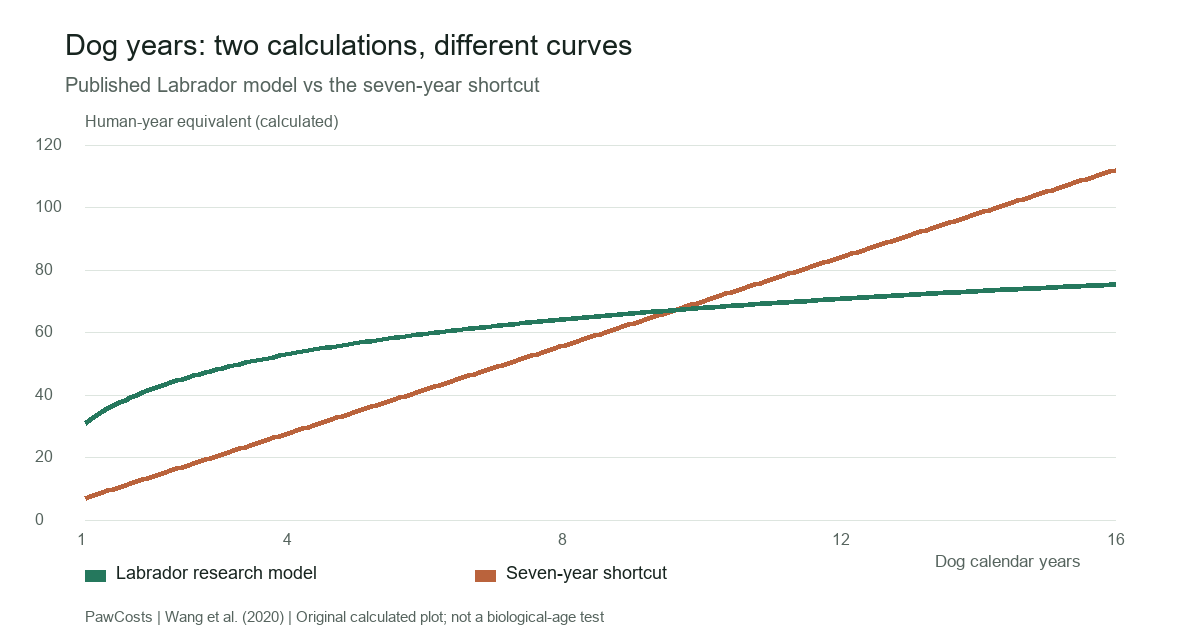
Shortcut
7 × calendar years
At 1 year it gives 7; at 10 years it gives 70.
Published model
16 × ln(calendar years) + 31
ln is the natural logarithm. At 1 year the model gives 31; at 10 years it gives 67.8. We retain the published coefficients.
The study compared methylation patterns from 104 Labrador retrievers with human data. It is not a breed-by-breed conversion chart or an individual biological-age test. Wang et al., Cell Systems (2020).
Age conversion table: 1 to 16 years
| Dog age | Seven-year shortcut | Labrador model |
|---|---|---|
| 1 | 7 | 31.0 |
| 2 | 14 | 42.1 |
| 3 | 21 | 48.6 |
| 4 | 28 | 53.2 |
| 5 | 35 | 56.8 |
| 6 | 42 | 59.7 |
| 8 | 56 | 64.3 |
| 10 | 70 | 67.8 |
| 12 | 84 | 70.8 |
| 14 | 98 | 73.2 |
| 16 | 112 | 75.4 |
Breed lifespan is a different question
McMillan et al. (2024) report UK population survival estimates. These numbers are not human-age equivalents and do not alter either calculation above.
- UK median survival
- 95% confidence interval
- Breed records
A population median is not life expectancy at birth, healthy-life duration or a countdown for an individual. Subtracting the current age would not give an estimate of years remaining.
Open the full breed recordMixed or unlisted breed? No breed value is assigned. Explore the available cohort records.
146 mapped breed records from Supplementary Table S3. Read the cohort study. Download these source-labelled records.
From a number to useful context
Questions about dog years
Is one dog year really seven human years?
Multiplying by seven gives the same rate at every age. The published Labrador methylation model is nonlinear: its equivalent increases more quickly at younger ages and more slowly later. These are different calculations, not two measurements of your dog.
Does choosing a breed change the human-age calculation?
No. The breed selector opens a separate UK survival record. PawCosts does not combine that record with the Labrador formula or invent a breed correction. A median is not years remaining.
Why is the research result unavailable for some ages?
This calculator displays the research model only from 1 to 16 years. That is an editorial display limit, not a validated clinical range. The study included younger puppies, but a single logarithmic formula is not a puppy-care guide. Calendar age remains available outside that range.
Is this a biological-age test?
No. This tool uses the age you enter, not a DNA sample, examination or health measurements. It cannot measure biological age, predict lifespan, assess disease or determine treatment.
Sources and reuse
Source check and calculation version: . No veterinary reviewer sign-off is claimed. This is an educational comparison of published methods and cohort records, not diagnosis or care advice.
- Wang et al. (2020), dog-to-human methylation model · Author-hosted paper.
- McMillan et al. (2024), UK dog survival cohort · Supplementary Table S3, CC BY 4.0.
- AAHA canine life-stage calculator, a separate clinical-context resource.
For an article explaining dog years, cite the original study and this calculator's version. The original comparison chart and calculated table are available under CC BY 4.0; the research paper and other site assets retain their own terms.